 Seonglae Cho
Absolute vs. Relative Optimization:
- Absolute Optimization (Utilitarianism): Maximizing benefits for everyone.
- Relative Optimization (Nash equilibrium): Maximizing individual benefits while maintaining balance with others.
- Price of Anarchy: The degree to which individual selfishness hinders overall social optimization.
- Braess Paradox: When excluding the fact that wrong choices (e.g., adding a specific path) can disrupt equilibrium, utilitarianism and Nash equilibrium can achieve the same ideal results.
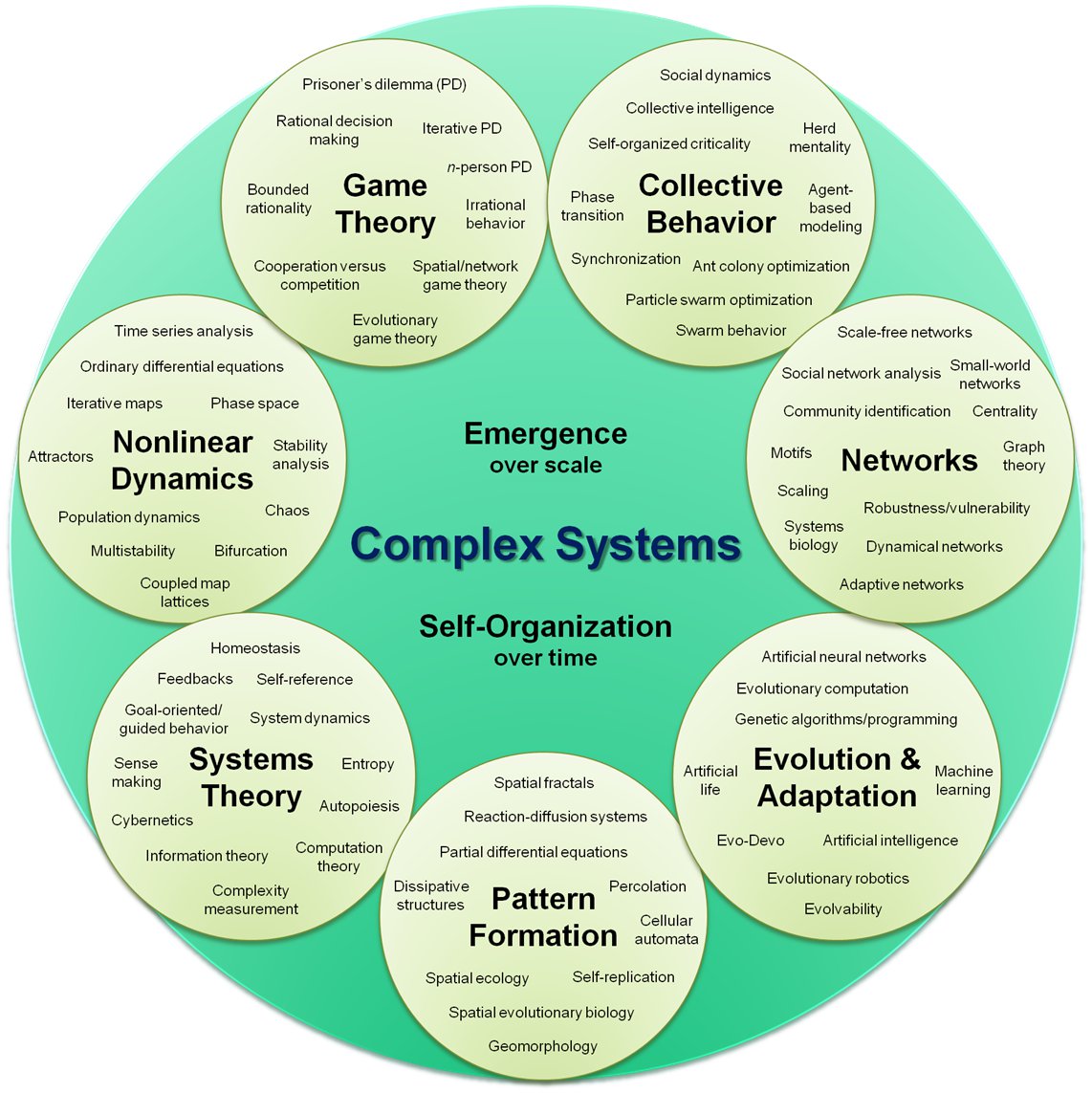
Complex System Fields
Complex vs. Complicated
- Complicated: Structural and predictable systems with repeatable solutions
- Complex: Unique and unpredictable systems requiring adaptive and innovative approaches
Properties
- Emergent Behavior: Impossible to predict overall behavior from individual components alone
- Delayed Consequence: Effects of actions appear later rather than immediately
- Local vs. Global Optimization: Local optimization can negatively impact the whole system
- Hysteresis: System continues to be influenced by past states even after they're gone
- Nonlinearity: Small changes can cause large ripple effects or sudden boundary shifts