 Seonglae Cho
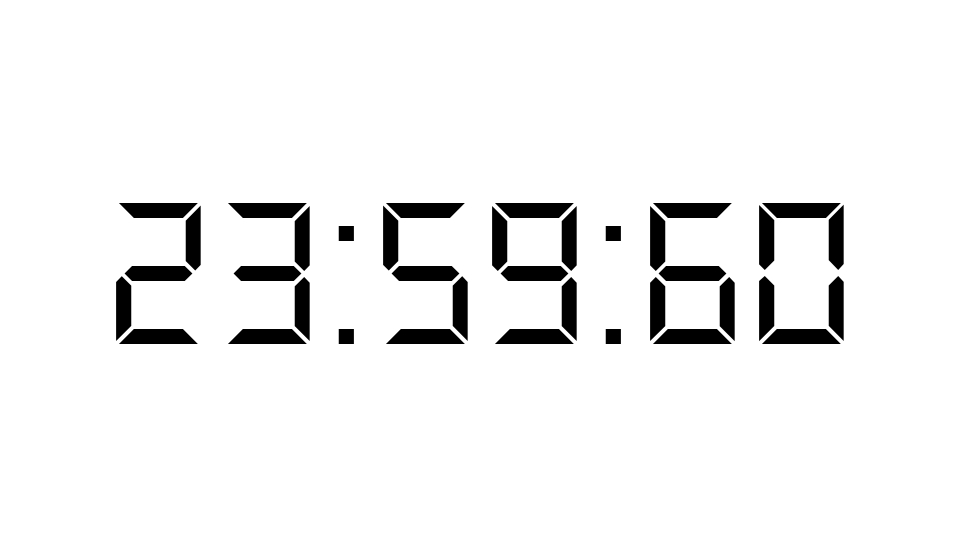
A leap second is an additional second added to Coordinated Universal Time (UTC) to correct for the discrepancy between the cesium atomic clock standard and solar time based on the Earth's actual rotation and revolution speed. Currently, leap seconds are added to maintain the difference between UTC and solar time within ±0.9 seconds. It is added either at the end of December 31st or at the end of June 30th.
Seconds Since the Epoch
This is not at all news, but it comes up often enough that I think there should be a concise explanation of the problem. People, myself included, like to say that POSIX time, also known as Unix time, is the number of seconds since the Unix epoch, which was 1970-01-01 at 00:00:00.
https://aphyr.com/posts/378-seconds-since-the-epoch
The leap second's time is up: world votes to stop pausing clocks
The practice of adding 'leap seconds' to official clocks to keep them in sync with Earth's rotation will be put on hold from 2035, the world's foremost metrology body has decided. The decision was made by representatives of governments worldwide at the General Conference on Weights and Measures (CGPM) outside Paris on 18 November.

https://www.nature.com/articles/d41586-022-03783-5

Problems
Problematic second - SarvenDev
Today, each of us has many possibilities to check the current time. We have smartphones, watches, computers, TVs, refrigerators, ovens, etc. Everyone knows what a year is and what it signifies. We understand time zones and UTC time. Everything seems trivial. However, from the point of view of IT systems, there are many surprises that we can encounter. Unfortunately, this causes us to face problems that occur very rarely.

https://sarvendev.com/2024/07/problematic-second/