 Seonglae Cho
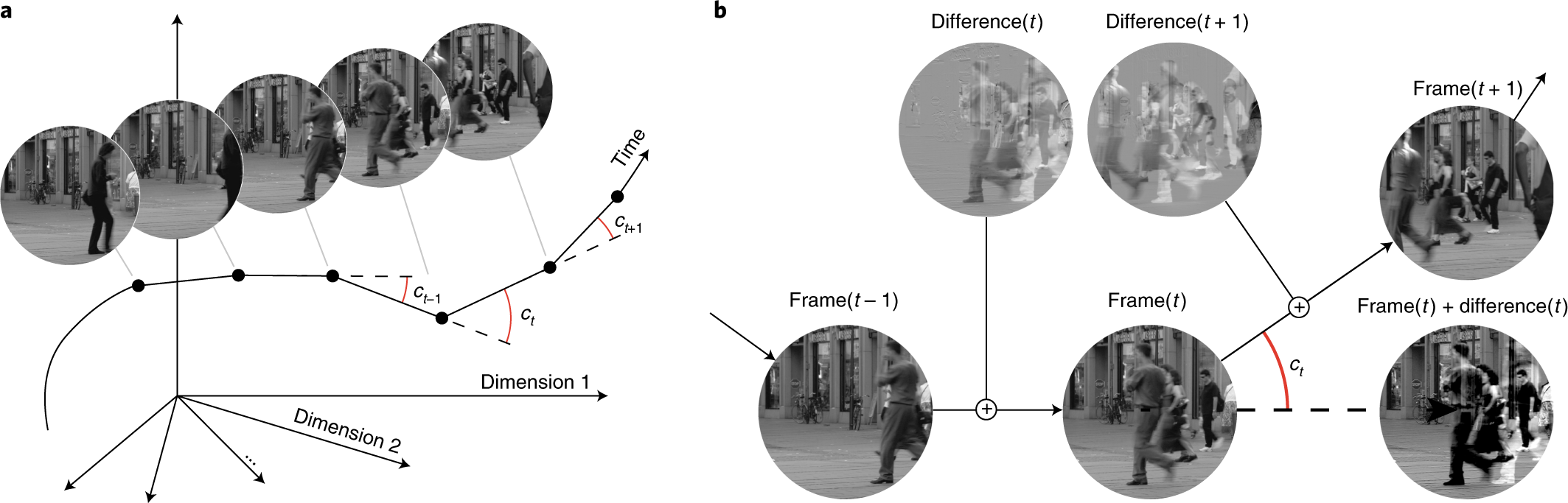
This hypothesis proposes that animals’ visual cortex takes in complex, nonlinear spatiotemporal visual inputs, such as natural videos, and transforms them into straighter, simpler trajectories within the brain’s internal perceptual representation space. The core claim is that by “linearizing” dynamic physical stimuli, the brain can more easily predict future events and support flexible behavior without requiring complex computations. Psychophysical judgments suggest that natural video sequences that are highly curved in pixel space are represented as more straightened trajectories by the human visual system. Using hierarchical artificial neural network models, the work further shows, via quantitative analysis, that as feature-extraction layers deepen, the curvature of activation trajectories tends to decrease, consistent with progressive straightening.
Because this hypothesis mainly focuses on relatively low-level motion stimuli and (comparatively) static natural-video inputs, it leaves open whether the same straightening mechanism also predominates in higher-level perceptual tasks that involve complex cognitive inference or multisensory integration.
Perceptual straightening of natural videos
Nature Neuroscience - The brain predicts future sensory input. The authors hypothesize that the visual system achieves this by straightening the temporal trajectories of natural videos, and they...

https://www.nature.com/articles/s41593-019-0377-4