 Seonglae Cho

with understanding of tensor products
mathatically 이해하려는 시도 → computing으로 의도 조절
- why you want to study Artificial Intelligence for Sustainable Development at graduate level
- why you want to study Artificial Intelligence for Sustainable Development at UCL
- what particularly attracts you to this programme
- how your academic background meets the demands of this challenging programme
- where you would like to go professionally with your degree
SDG
- Ensure access to affordable, reliable, sustainable and modern energy for all
- Build resilient infrastructure, promote inclusive and sustainable industrialization and foster innovation
Except considering 17 SDGs, we might have to focus on the sustainability itself.
For AI’s sustainable development goal, the first thing to do is aligning human intention with the AI’s preference which could prevented by inequality stereotype sometimes appears on AI. For future education, the more AI will be used that might have huge impact to cultural perspective from AI’s preference.
AI alignment is the core essential for maintaining factual consistency. AI alignment can only be achieved by analyzing foundational computing unit for AI models which are the goal for Mechanistic Interpretability.
AI’s main concern is definetly energy consumption. Data efficient approach is required for less energy consuming independent with GPU unit’s ability. It is obvious that the way to find energy saving is go along with artificial intelligence’s support which could be a great aid for future findings
discrete road vector was drawn per at least 3 meter to reduce AI model’s energy consuption 내용을 vector map protocol 다음이나 적절한 곳에 추가
My genuine interest in Artificial Intelligence (AI) stems from a blend of intellectual curiosity and practical concern. Aware of the potential threats posed by AI, I have a particular interest in understanding how Large Language Models (LLMs) function. This curiosity motivated me to investigate Explainable AI, specifically Mechanistic Interpretability. My goal is to uncover the underlying mechanisms behind AI and optimize AI preferences to match human intentions. This is crucial for preventing inequality bias as AI becomes a tutor in future education. This passion for interpretable AI, which supports the Sustainable Development Goals (SDGs), guided my research into decision-making within AI summarization, which was accepted at NAACL 2024. Additionally, my three years of work experience in the autonomous driving technology sector have reinforced my belief in the necessity of a thorough grasp to ensure the safe and precise operation of AI.
Three years of software engineering at a startup and a major tech company in South Korea’s mobility sector are among the most enriching experiences of my life. Starting with two years at the mobility startup Stryx, I began by connecting software and hardware, gaining hands-on experience in sensor equipment. It enabled me to develop knowledge of sensor fusion, the starting point of the autonomous driving data pipeline. Later, I took responsibility for the latter part, the vector map generation, providing an overall insight into the data flow. This vertical understanding was instrumental in improving the pipeline, which established me as a key player. My significant contributions led to the delivery of map data for Korea’s first driverless service company, 42Dot, and facilitated Stryx’s successful acquisition by Kakao Mobility.
At Kakao Mobility, a dominant company in Korea's mobility sector, I led the development of the map platform and designed an API (Application Programming Interface) protocol for an AI feature bridging machine learning algorithm. Furthermore, Kakao Mobility’s testing of a robo-taxi for public use under real-world conditions in Pangyo offered me firsthand exposure to the technology, which profoundly changed my perspective of AI. I experienced some stiffness in driving due to the discrete vector of the lane map because I knew the data under the hood. I realized that understanding internal AI systems is critical for investigating operational problems, as data plays a crucial role in AI system operation. After encountering that limitation, which I felt could not be resolved through industry exposure alone, I became convinced that a deeper academic understanding of AI was essential for making meaningful contributions to the field.
Driven by my resolve to delve into the mechanisms of AI, my return to academia after work experience led me to focus on Explainable AI, aiming to reveal the inner process of AI systems. As an intern at Yonsei University’s Data Intelligence Lab, I had the opportunity to research making AI summarization interpretable. My work on training the RTSum (Relation-Triple Summarization) model and creating the dataset for the RTSum framework, which split and recombined information at a granular level, led to our paper’s acceptance at NAACL 2024. This not only enhanced my research skills but also confirmed my belief in the importance of a thorough understanding of the underlying computing for effectively directing LLMs.
My affirmed belief in an interpretable approach to AI spurred me to actively engage in scholarly dialogue for Interpretable AI. Drawing from Anthropic's research on the interpretability of Transformer models, I explored the role of attention heads in forming in-context learning and conducted in-depth research on the functions of LLMs through OpenAI's Transformer Debugger. I reinterpreted this research and shared it with the AGI (Artificial General Intelligence) Korea group, aiming to highlight my perspective on grasping AI. In particular, Lewis D. Griffin’s recent work on 'Use of LLMs for Illicit Purposes: Threats, Prevention Measures, and Vulnerabilities' at University College London aligns with my purpose and approach for AI safety and ‘Towards automated circuit discovery for mechanistic interpretability’ from UCL’s PhD students analyzing from basic computing units of LLM, which offer a unique academic environment that aligns with my research interest.
Mechanistic Interpretability, which requires graduate-level understanding of AI, makes UCL the perfect place for study. I am eager to demonstrate how my bottom-up approach would be helpful for models’ reduced energy consumption along with computational efficiency. For an elective module, I hope to take ‘Accountable, Transparent, and Responsible Artificial Intelligence’ which is ideal for my career objective. This educational process will be instrumental in achieving my career goal for AI safety and contributing to AGI (Artificial General Intelligence) alignment.
My professional experience and academic research have taught me that ensuring AI operations function as intended requires an understanding of fundamental computing units. Analyzing the internal workings of mathematical computing in LLMs through Mechanistic Interpretability is a critical and promising research area for AI alignment. The primary challenge of large AI models today is their high energy consumption. However, computation-based approaches can optimize processes, leading to more efficient energy use. I am confident in my ability to advance my research goals by leveraging University College London’s ideal environment, which offers a well-balanced curriculum and a diverse array of professors.
Artificial Intelligence for Sustainable Development
Artificial Intelligence for Sustainable Development MSc
Tackle emergent challenges through this one-of-a-kind MSc programme that brings the technical side of Artificial Intelligence (AI) together with environmental and humanitarian issues. This is an incredible opportunity to find solutions to pressing problems in sustainable development. Taught at UCL, an international home of AI breakthroughs, this programme places graduates at
https://www.ucl.ac.uk/prospective-students/graduate/taught-degrees/artificial-intelligence-sustainable-development-msc
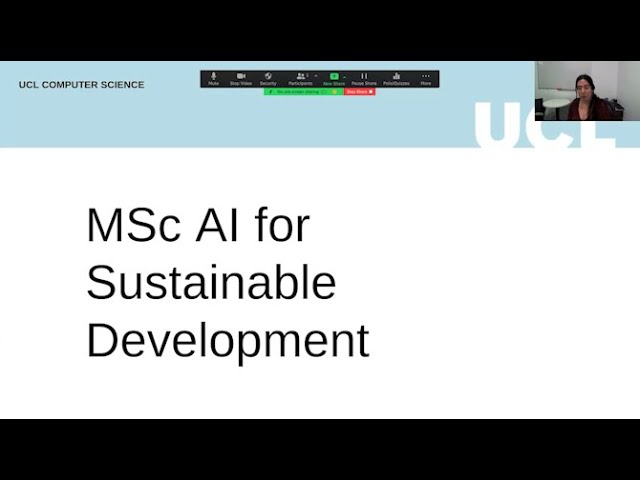
AI for Sustainable Development MSc - programme overview at UCL Computer Science Department
Associate Professor Maria Perez Ortiz, Programme Director of the AI for Sustainable Development MSc course at UCL, gives an overview of the programme.

https://www.youtube.com/watch?v=M0PXxYTi5Js