 Seong-lae Cho
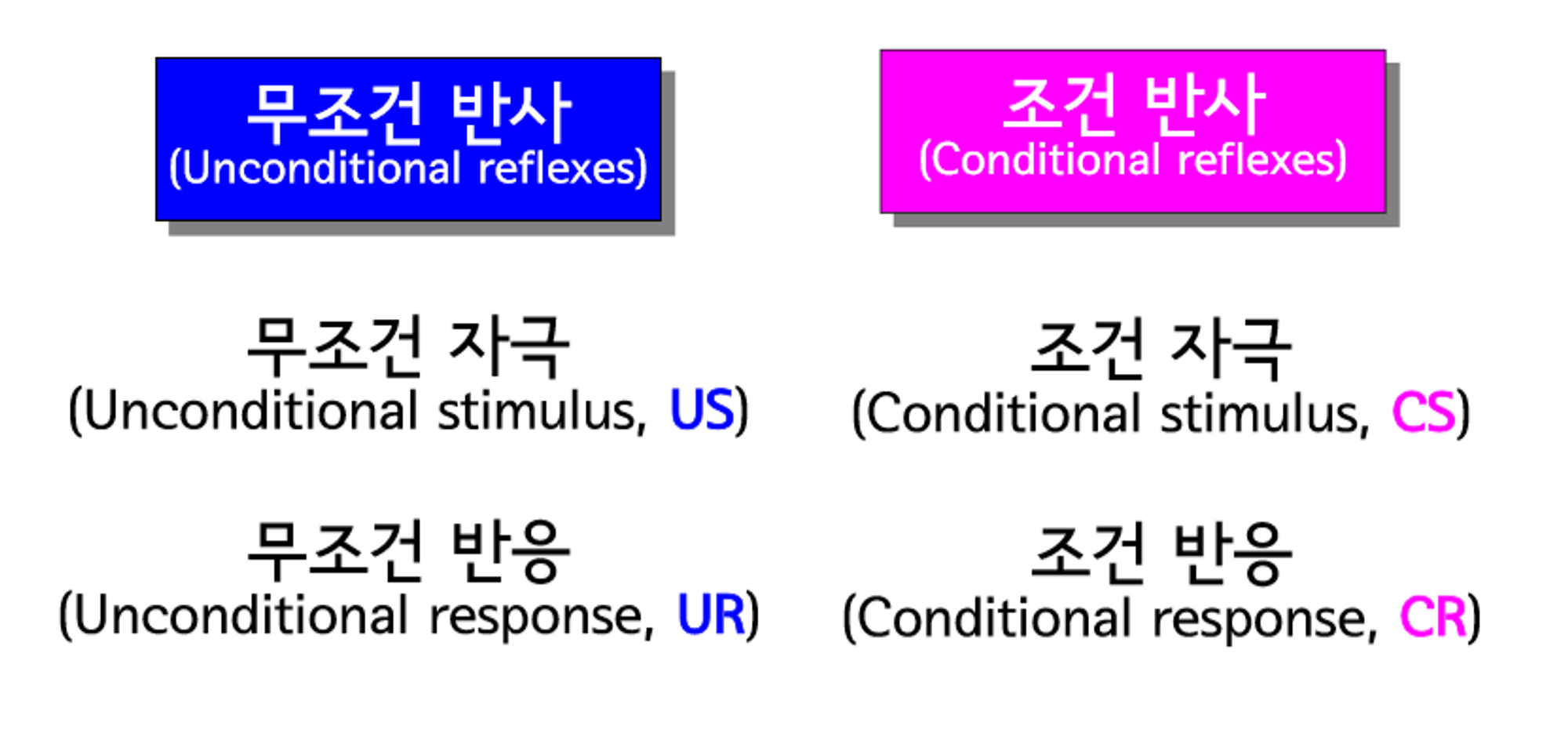
Unconditioned reflexes (innate reflexes) can be described by the equation below.
Unconditioned response (UR) → Unconditioned stimulus (US)
“Unconditioned” means it is independent of whether learning has occurred.
Unconditioned reflexes are innate reflexes.
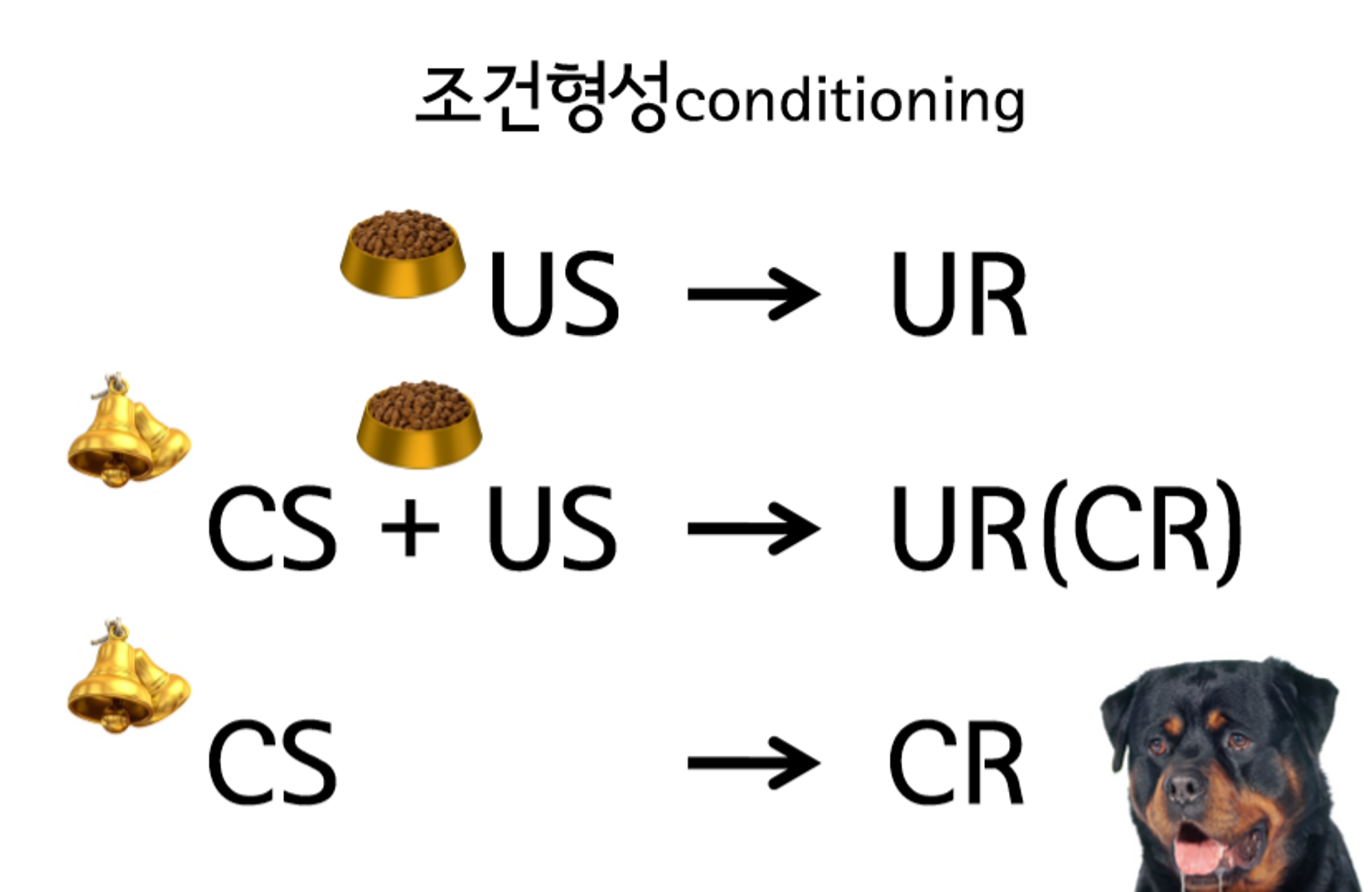
Conditioning
Does not require conscious awareness.
The process through which a conditioned reaction/response develops.
Preparatory Response Theory
Cue + stimulus → response (the equation itself is a reflex).
Conditioned cue → preparatory response (the body prepares) → a state ready to receive the reflex (CR). The UR is the state produced when the unconditioned stimulus is actually received.
Tolerance: In addiction, there are also cues, and tolerance can be conditioned.
→ In an unfamiliar context, tolerance may not occur; with excessive stimulation/dose, it can be fatal.
Tolerance responds to the cue + stimulus pairing.
Conditioned emotional response
Most emotional responses are learned (conditioning) → fear generalization (if fear is learned for “something white,” it generalizes to other white things) → many phobias.
If a consistent conditioned stimulus (e.g., “at night, at a pub with coworkers”) always precedes an unconditioned stimulus (“alcohol”), the body uses that conditioned stimulus to produce a preparatory response that reduces the effect of the unconditioned stimulus (1). During the day, because the conditioned stimulus is absent, the body fails to produce the preparatory response, so alcohol has a stronger effect.
Fear
Adaptive characteristics
- develops quickly (fast)
- hard to forget (long-lasting)
Universality: similar to animals’ fear-learning patterns
Two types of fear
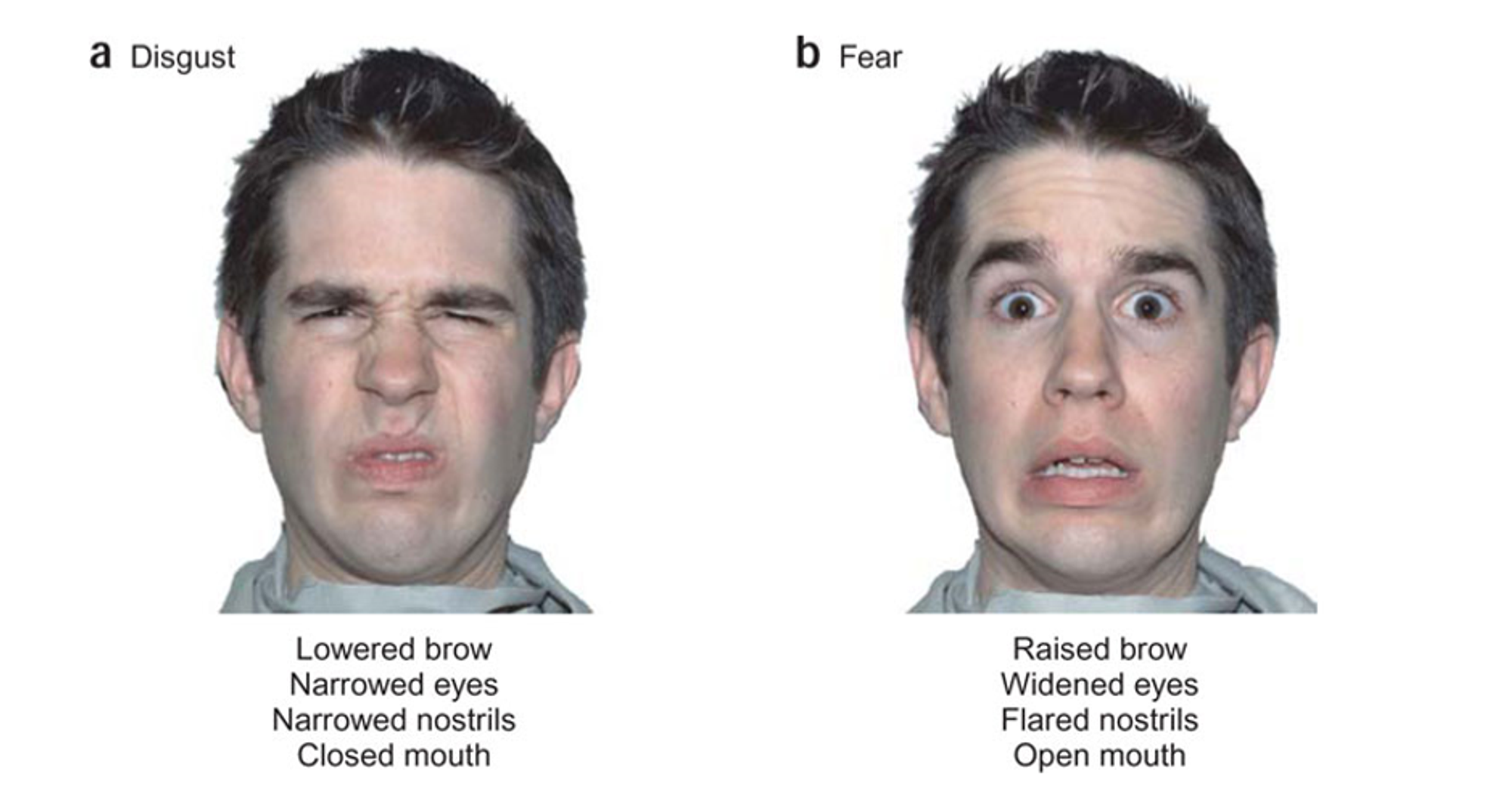
1. Disgust: fear of contamination (and + immorality)
e.g., taste aversion — forms quickly after a single trial.
Even when the CS–US interval is long, it can form easily.
If it links to other US/CS, it tends not to link with familiar items.
2. Fear: fear of bodily harm
Whether fear is present is judged by freezing behavior: a result/indicator of fear.
In fear conditioning, the US is typically something that produces pain for the UR (e.g., electric shock, UV, etc.).
Conditioning (Biology)
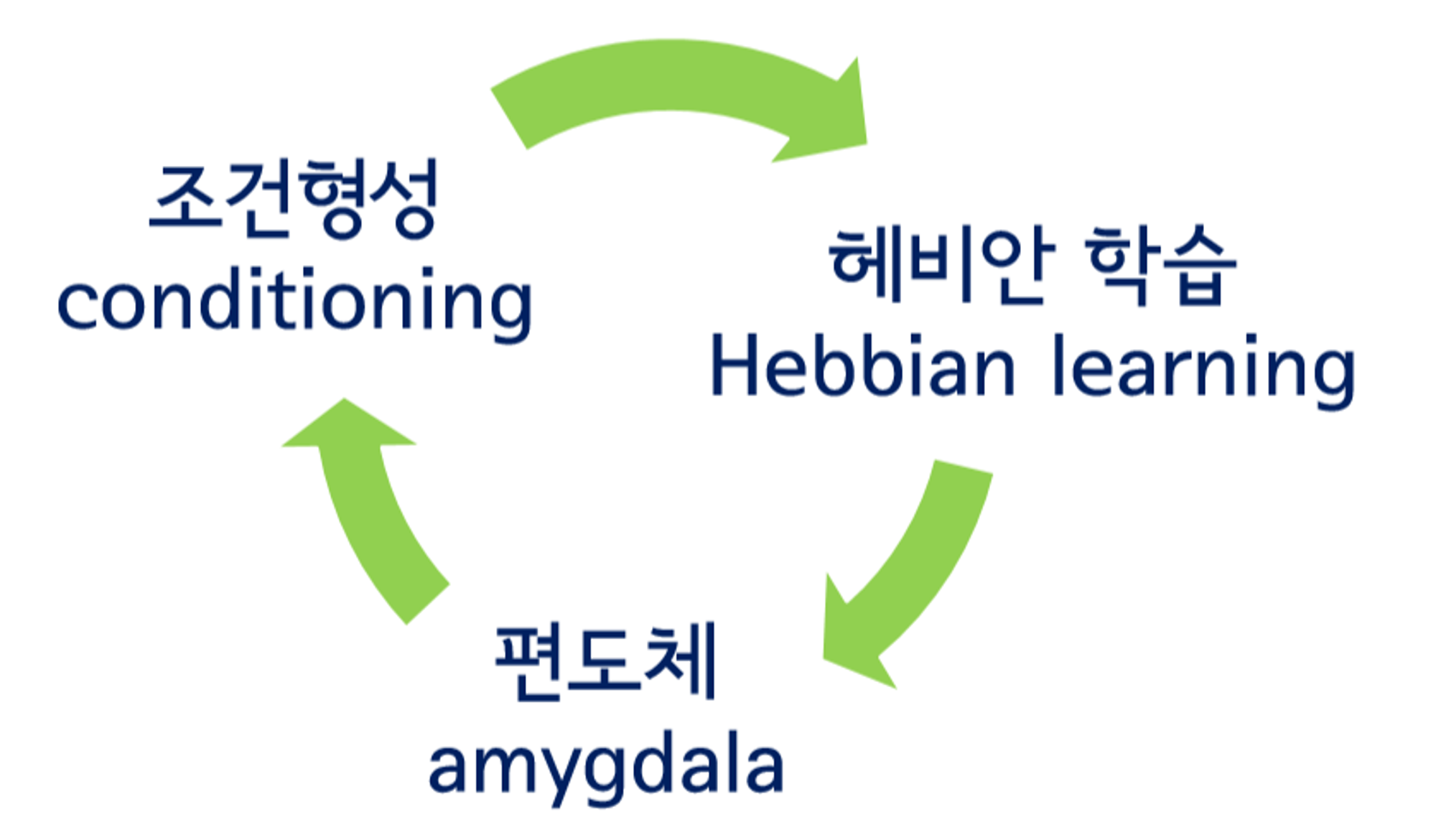
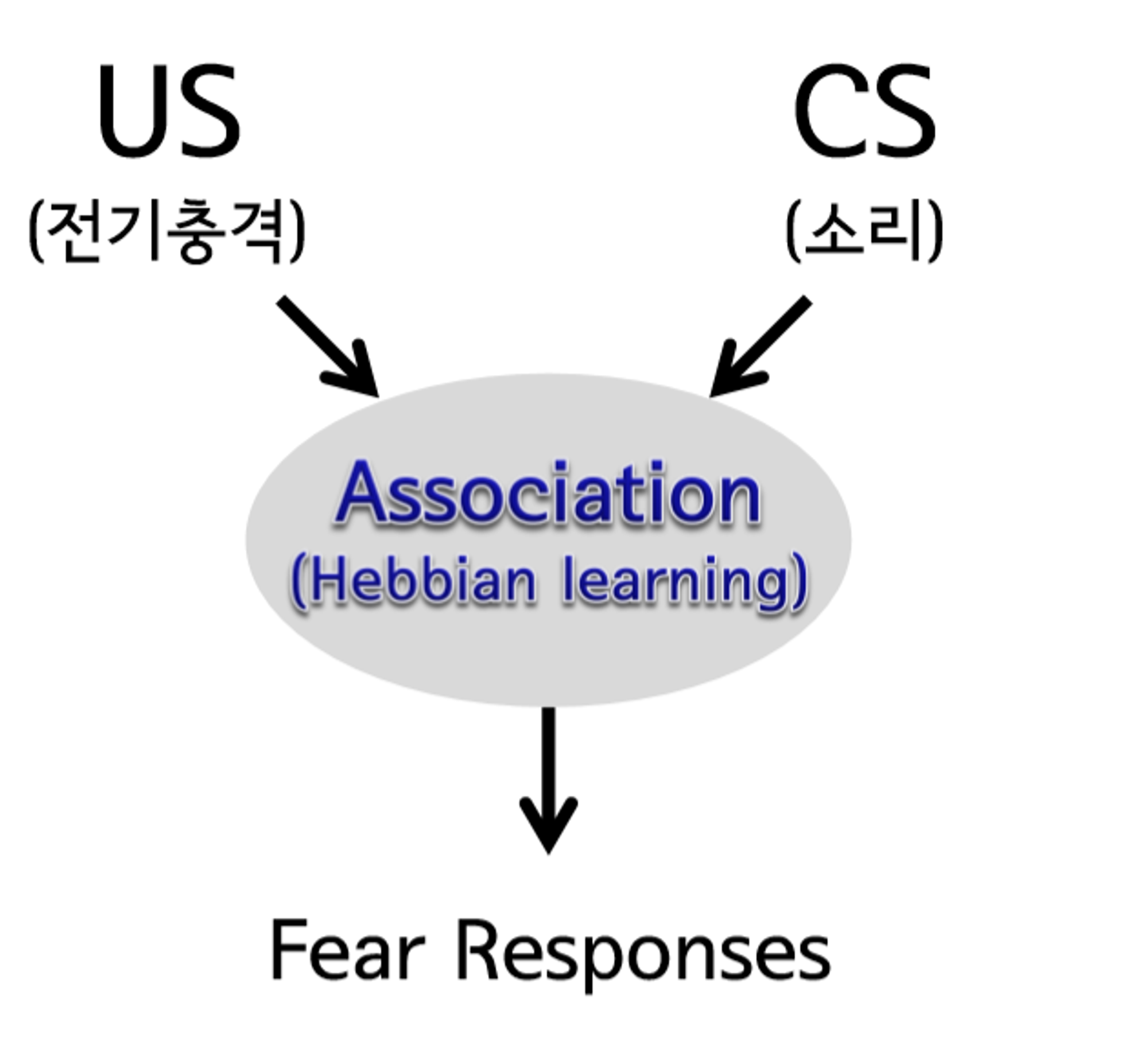
Hebb’s Rule / Hebbian Learning (association): when the axon of cell A repeatedly contributes to firing cell B → structural changes (spines), hormone increases, distance decreases.
→ metabolic changes = lower threshold → higher efficiency
Biological interpretation of conditioning
Learning can strengthen connections, but connections can also weaken.
Fire together, wire together
Evidence that the fear cue is being remembered
Between the US and CS
NMDA receptor (synaptic coincidence detector) — when coincidence is detected, Ca²⁺ induces long-term synaptic changes (e.g., LTP, LTD).
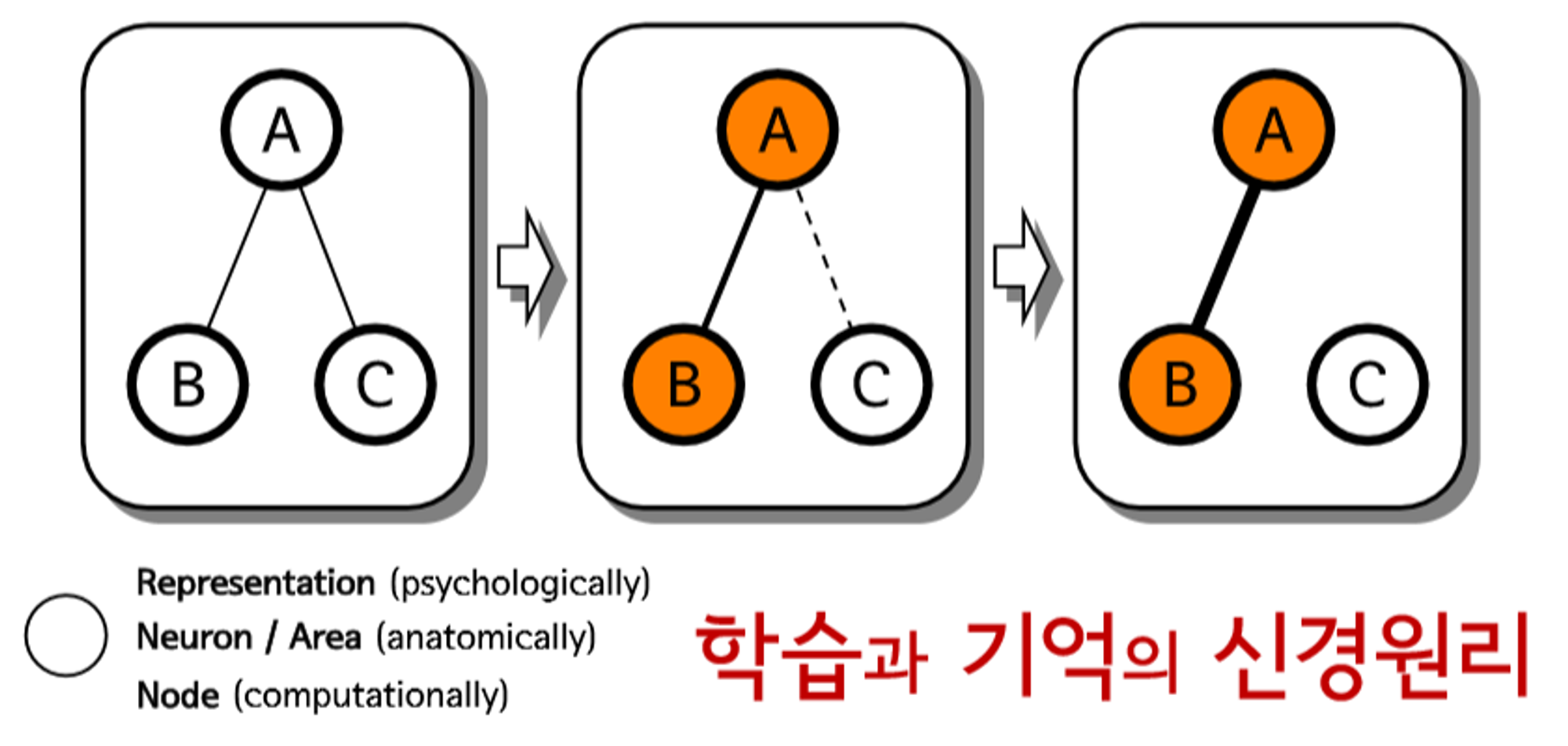
Because there are many academic fields, “node” can mean representation/area/neuron.
Memory control
If you activate NMDA receptors via genetic manipulation, memory improves; because experiences are well reflected in associative networks, fear is learned strongly (transgenic).
Conditioning magnitude is larger, and both fear conditioning and extinction are faster.
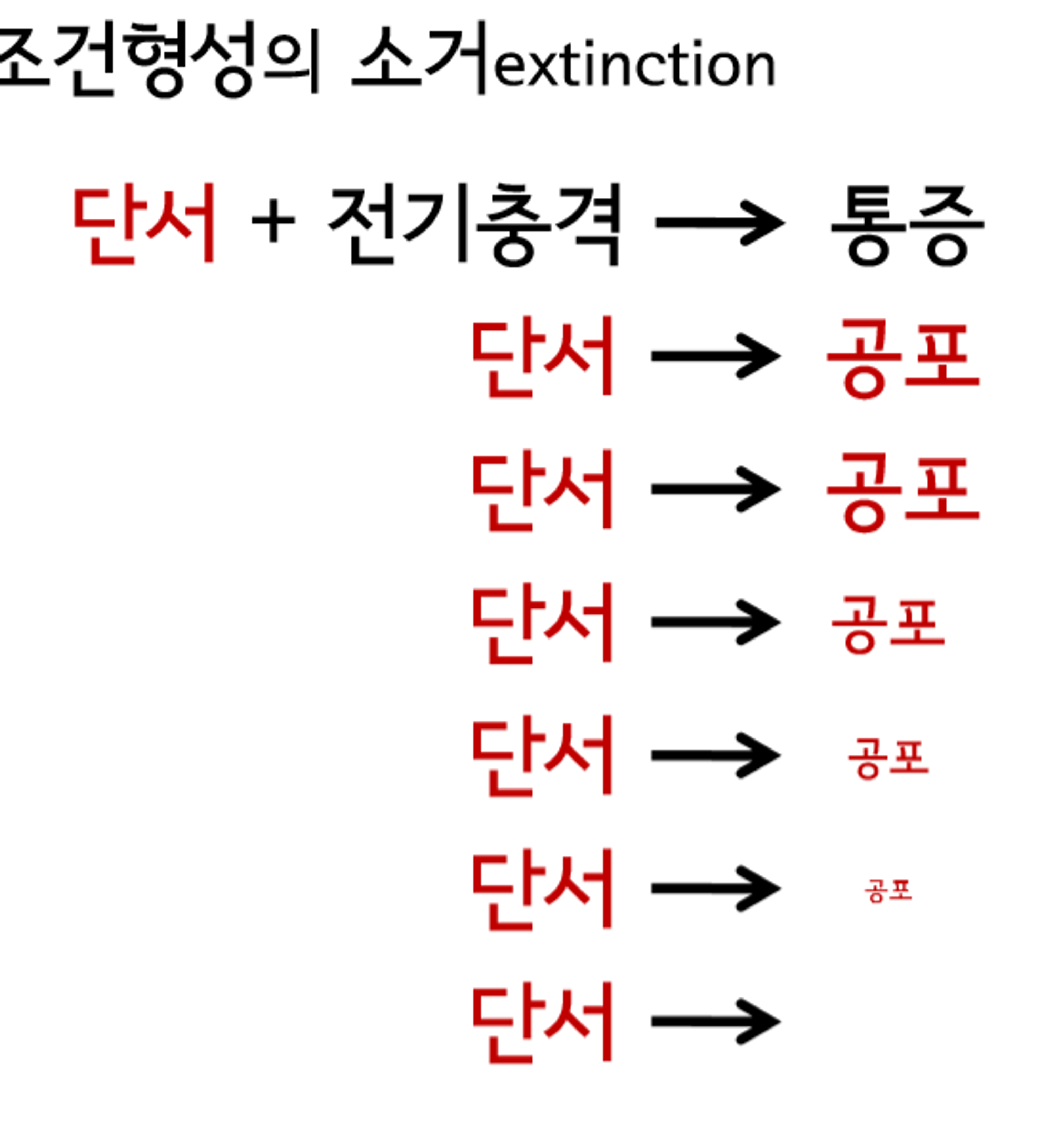
Extinction — when only the cue is presented