

 Seonglae Cho
Hard to separate
Digitizing smell is hard because it’s difficult to decompose an odor into a small set of independent, controllable “basis” components (unlike light, which can be approximated with a few primary colors).
A single rose scent involves more than 300 volatile compounds interacting dynamically, which is why fully digitizing smell remains a challenging problem.
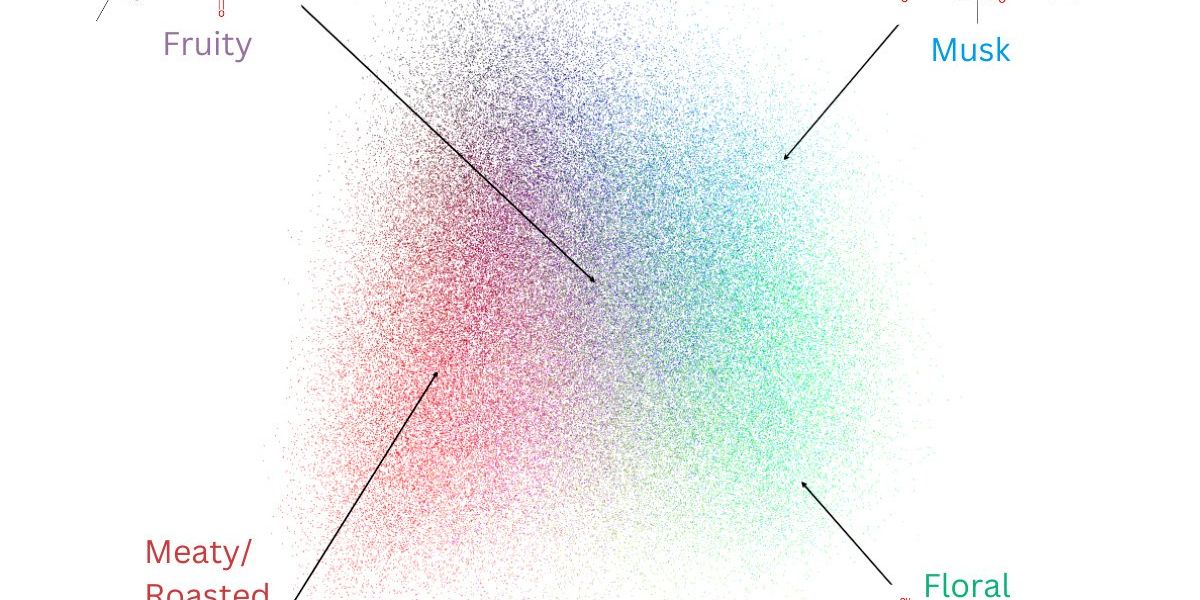
Tech companies such as Google and Osmo are changing the fragrance industry by learning the relationship between molecular structure and odor (Structure-Odor Relationship), then predicting scents and visualizing them as a digital map called the Principal Odor Map (POM).
They analyzed over 5,000 fragrance molecules to produce a 63-dimensional “odor embedding,” achieving 85% agreement with expert human judgments. Building on this, Osmo reportedly discovered a non-toxic mosquito repellent to replace DEET and reproduced the same scent as one ounce of rose oil using synthetic molecules instead of the roughly 60,000 flowers normally required.
Scent, In Silico
Once a primal instinct, olfaction is now being mapped, measured, and modeled by machines.

https://www.asimov.press/p/scent

Digitizing Smell: Using Molecular Maps to Understand Odor
How can we measure a smell? Smells are produced by molecules that waft through the air, enter our noses, and bind to sensory receptors. Potentially billions of molecules can produce a smell, so figuring out which ones produce which smells is difficult to catalog or predict. Sensory maps can help us solve this problem.
https://ai.googleblog.com/2022/09/digitizing-smell-using-molecular-maps.html

This Neural Net Maps Molecules to Aromas
Sights and sounds are easily digitized, but scents have eluded researchers until now

https://spectrum.ieee.org/digital-smell
Machine Learning for Scent: Learning Generalizable Perceptual...
Predicting the relationship between a molecule's structure and its odor remains a difficult, decades-old task. This problem, termed quantitative structure-odor relationship (QSOR) modeling, is an...

https://arxiv.org/abs/1910.10685
