
 Seong-lae Cho
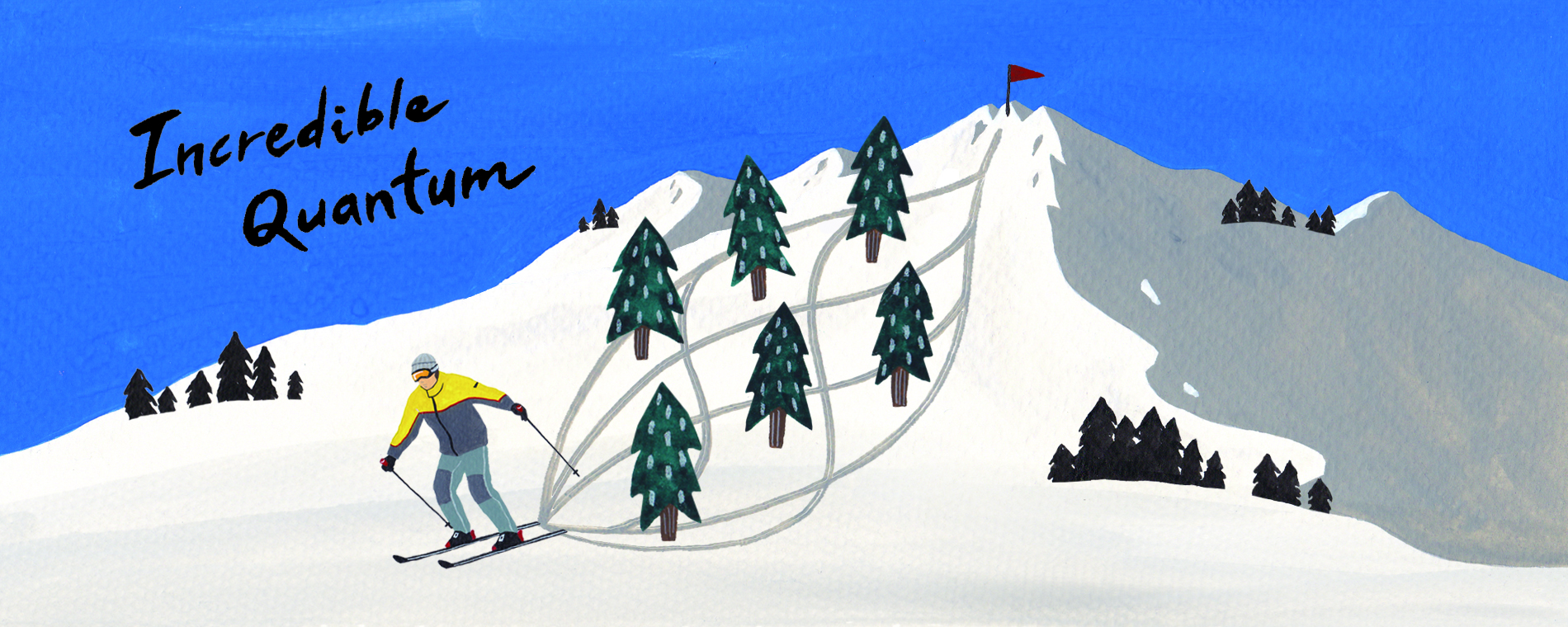
The Feynman path integral begins with a simple picture: a particle passing through infinitely many slits behaves just like a particle moving through empty space. From this view, it offers a way to find meaningful probability among infinitely many possible paths, where at each subdivided step of its motion the particle carries a probability of moving that is fixed by the uncertainty principle.
Principle of least action: the embodiment of Occam's razor in classical mechanics Minimizing the time of a particle's motion recovers classical mechanics
Because it sums over infinitely many possibilities, the path integral never allows faster-than-light paths, which also removes the need to rely on the Dirac equation. It even addresses a problem in quantum field theory: by integrating over the interactions of infinitely many excitable particles, it yields a meaningful probability amplitude. Yet while it can handle infinitely many paths, the problem may not be fully solved, since an event built from infinitely many events can again give rise to infinitely many events. To push past this, Feynman introduced one further idea.