

 Seonglae Cho
Hologram Usages
Disney's "Holobricks" could stack up for larger holograms
Holograms are one of sci-fi's longest promised technologies, and one of real science's longest-running disappointments. Scientists at Cambridge and Disney Research may be a step closer to making them less disappointing, creating new "holobricks" that can stack and tile together to produce large 3D...

https://newatlas.com/electronics/disney-holobricks-holograms
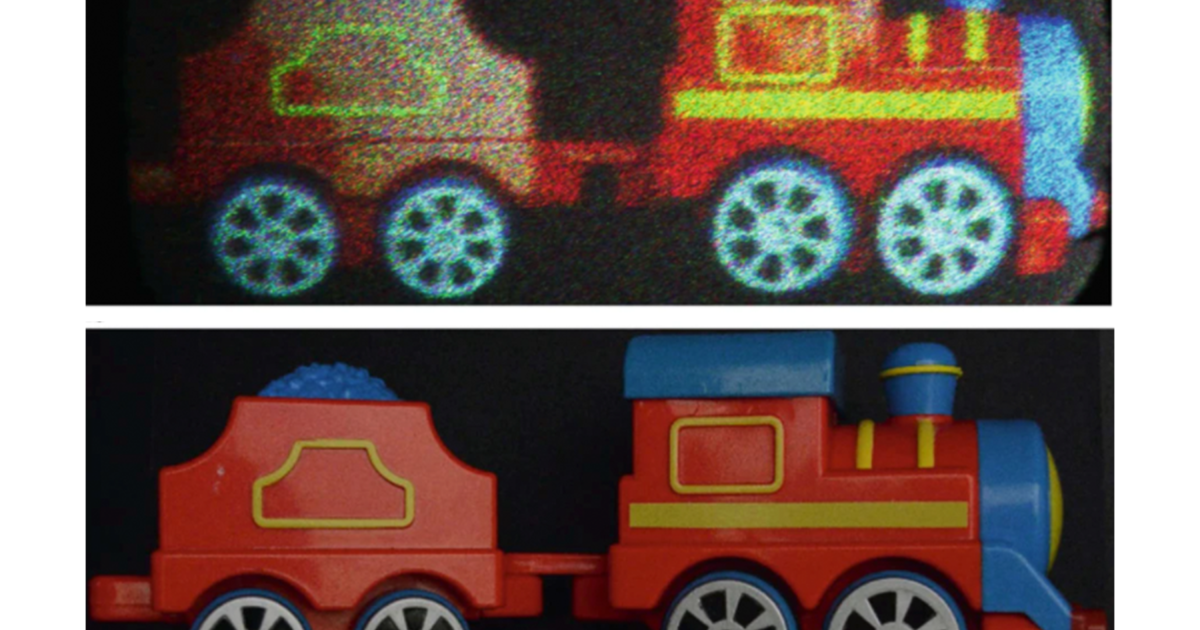
Deep Learning Enables Real-Time 3D Holograms On a Smartphone
While machine learning has been around a long time, deep learning has taken on a life of its own lately. The reason for that has mostly to do with the increasing amounts of computing power that have become widely available-along with the burgeoning quantities of data that can be easily harvested and used to train neural networks.

https://spectrum.ieee.org/realtime-hologram

Hologram Doctors Visit Space Station For The First Time Ever
Things are getting more and more like "Star Trek" every day. As NASA noted in a press release, a hologram medical team were "holoported" aboard the International Space Station late last year, making them the first people to have their 3D likenesses projected into outer space using technology from Microsoft and a startup called AEXA Aerospace.

https://futurism.com/the-byte/hologram-doctors-space-station

Interactive 3D hologram
Paper | FlexiVol: Reach-Through Volumetric Display with Elastic Diffusers
preprint: https://hal.science/hal-04981007v1
paper: https://doi.org/10.1145/3706598.3714315
Volumetric displays render true 3D graphics without forcing users to wear headsets or glasses. However, the optical diffusers that volumetric displays employ are rigid and thus do not allow for direct interaction. FlexiVol employs elastic diffusers to allow users to reach inside the display volume to have direct interaction with true 3D content. We explored various diffuser materials in terms of visual and mechanical properties. We correct the distortions of the volumetric graphics projected on elastic oscillating diffusers and propose a design space for FlexiVol, enabling various gestures and actions through direct interaction techniques. A user study suggests that selection, docking and tracing tasks can be performed faster and more precisely using direct interaction when compared to indirect interaction with a 3D mouse. Finally, applications such as a virtual pet or landscape edition highlight the advantages of a volumetric display that supports direct interaction.

https://www.youtube.com/watch?v=4wwKOXxX9Ck
