Verbalizable Representations Form a Global Workspace in Language Models
If the mind is an ocean, we spend our lives floating at the surface. Beneath us, an enormous amount of processing takes place without our knowledge: our visual systems parsing the contours of a face, our motor circuits maintaining our posture. At any given moment, only a small fraction of this neural activity is accessible to us. Yet it is this privileged sliver of activity that we rely on to reason deliberately: to plan what ingredients to buy for a recipe, or to puzzle out why an engine won’t start. Such thoughts can be articulated out loud, deliberately held in mind, and brought to bear on whatever task the moment demands. This distinction, between our accessible thoughts and our unconscious processing, is perhaps the most striking feature of human cognition.
http://transformer-circuits.pub/2026/workspace/index.html
A global workspace in language models
Interpretability research on Claude's internal thoughts.
https://www.anthropic.com/research/global-workspace

Jacobian Lens – Qwen3.6-27B
Revealing a Global Workspace in Language Models
https://www.neuronpedia.org/qwen3.6-27b/jlens?shareId=cmr1qav5a0008pt2xhsvp0scq

Welcome to the J-Space 🌌 | The Residual Stream
Jacobian Lens, HeadVis Updates, a 1.5B NLA, and more
https://www.neuronpedia.org/blog/jacobian-lens

J lens
It can provide clues for inferring the model’s internal algorithm, but for now it can only read a single token, which limits the scope of discovery; a multi-token approach will be needed in the future.

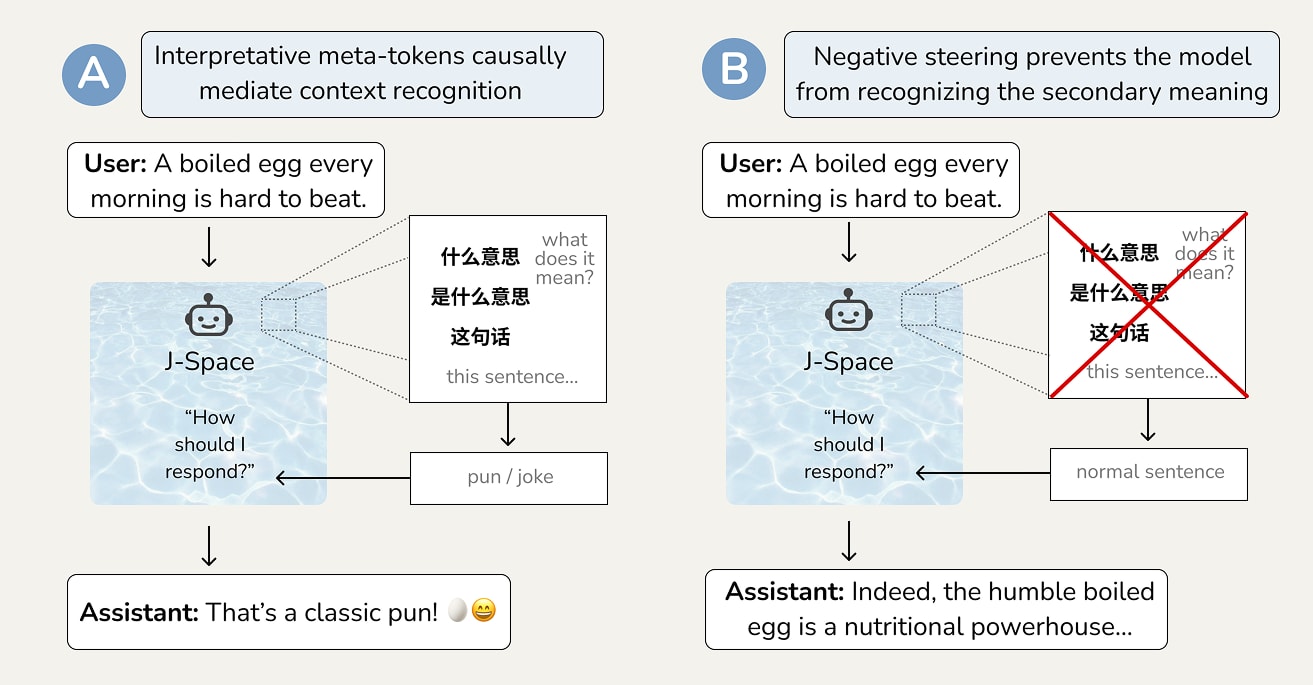
Towards surfacing model algorithms with meta-tokens in the J-Space — LessWrong
TL;DR We used J-lens on Qwen3.6-27B to find “meta-tokens”: tokens that surface non-obvious computation in the model. When the model reads ambiguous t…
https://www.lesswrong.com/posts/6ek6n7yZ5DzfarJHy/towards-surfacing-model-algorithms-with-meta-tokens-in-the-j
R lens
An improved version of J-lens that reduces early-layer interpretation noise. The key is using LRP (Layer-wise Relevance Propagation) rules in the backward pass instead of ordinary gradients. R-lens catches
sushi → Japan at layer 2, whereas J-lens only catches it at layer 14.R-lens: Making J-lens More Faithful on Early Layers — LessWrong
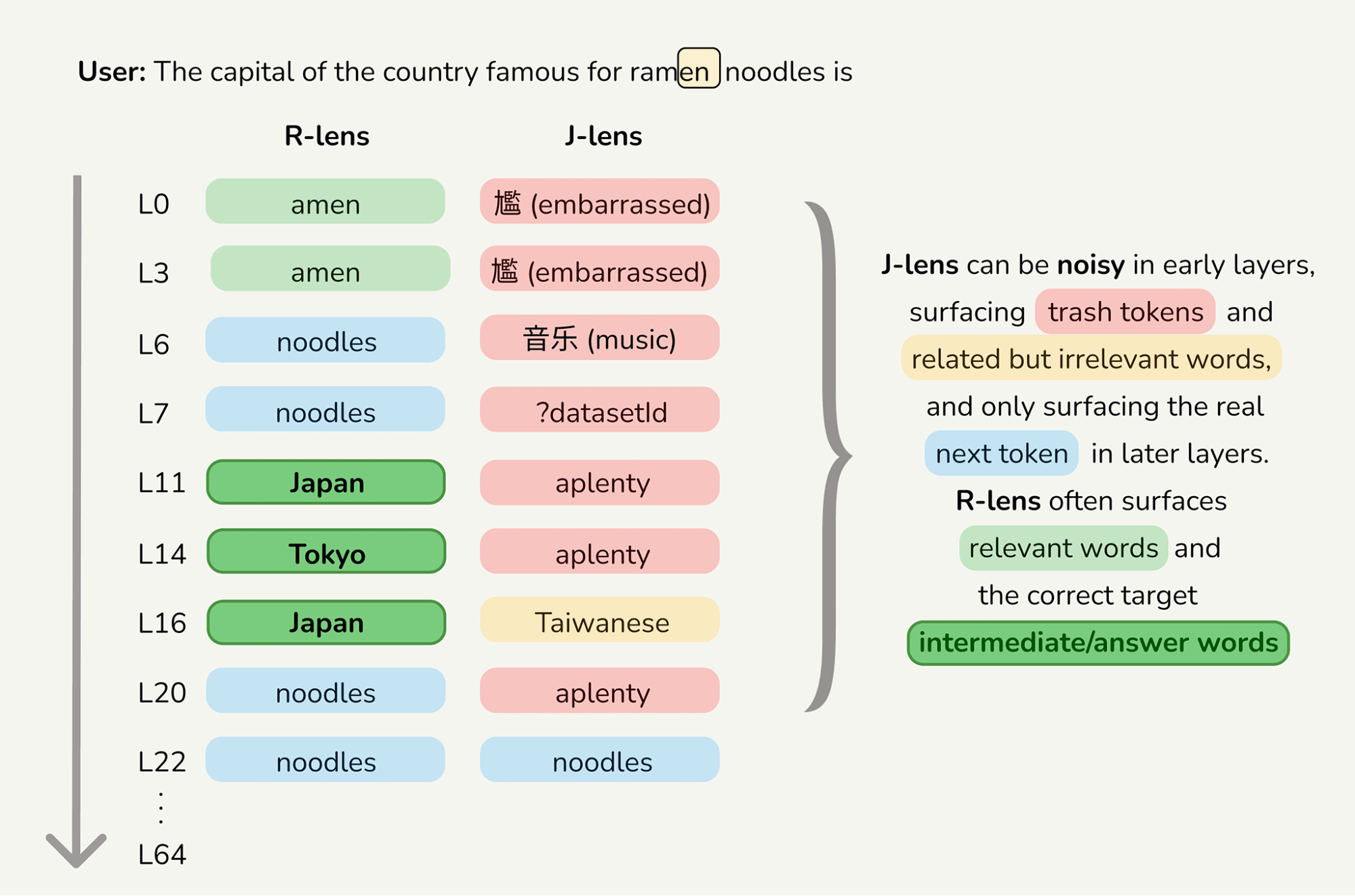
TL;DR: We introduce the R-lens: a drop-in replacement for J-lens that produces clearer readouts on earlier layers. R-Lens is identical to J-Lens, exc…
https://www.lesswrong.com/posts/nv8oedrnLXKRzNEL9/r-lens-making-j-lens-more-faithful-on-early-layers

Seonglae Cho