
 Seonglae Cho
Providing Github Pages with paper is a better way than a blog post
Writing paper is not about writing a blog post. Beyond simply providing good performance, it must provide insight. A good method to get a paper accepted is to write it so precisely verifying the idea that you lose the desire to refute it after reading the entire paper.
The terms like "substantial" are fairly weak and could be improved with specifics. Everything requires justification. Baseline and comparison are important, so make them explicit. Theoretical evidence, diverse perspectives, and consideration of wider applications are good approaches. Ensure every citation is included, even if duplicated. Provide deep analysis of limitations, substantial methods, and conclusions.
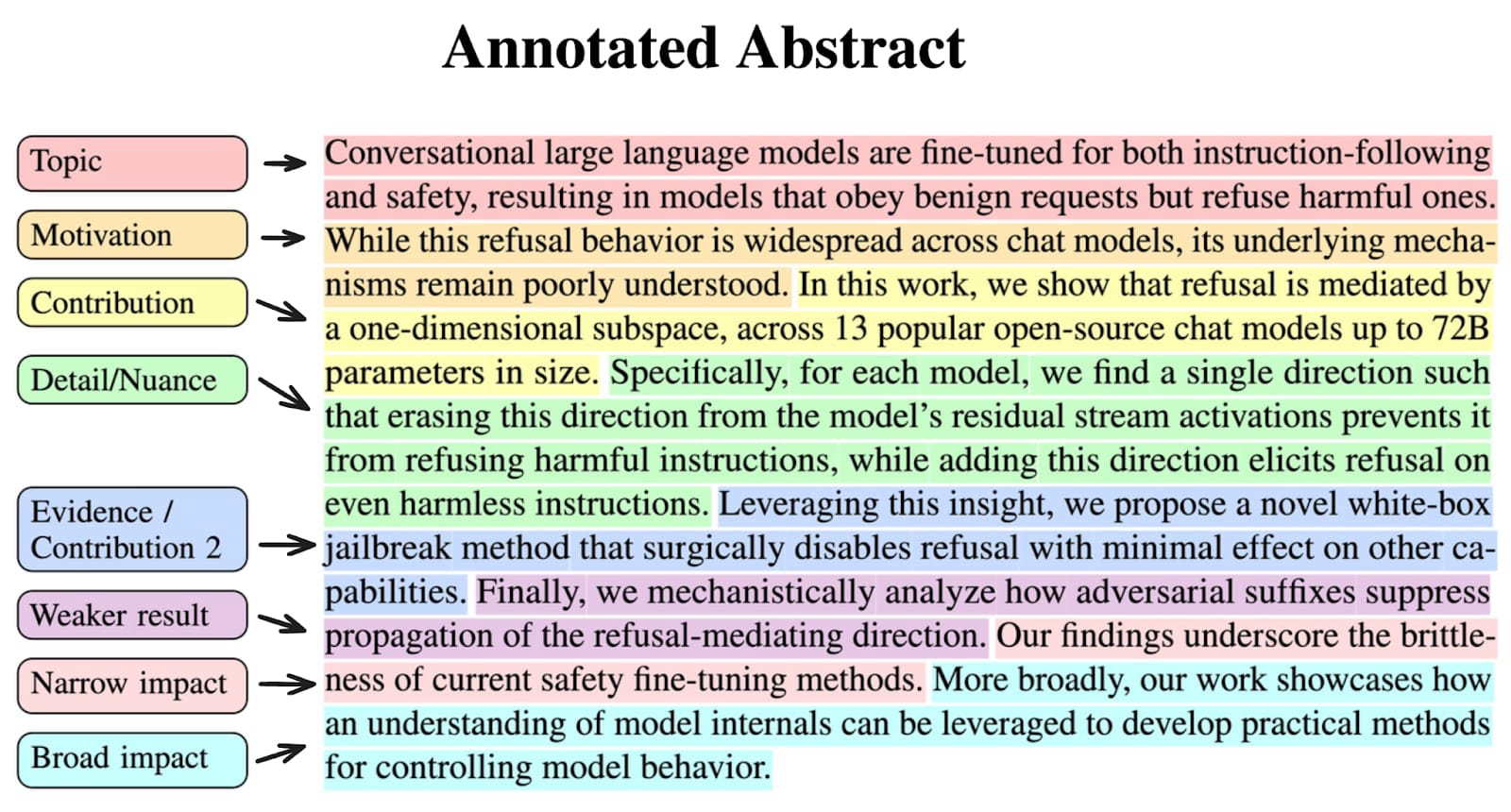
At its core, a paper should present a narrative of one to three specific concrete claims that you believe to be true, that build to some useful takeaway(s). Everything else in the paper exists to support this narrative. The second pillar of the paper is rigorous evidence for why they are true.
Support 1-3 key claims through experiments, actively defend against counterexamples and bugs, and conduct self-directed red-teaming experiments on your claims. Adjust the tone based on claim types like 'existence proof', 'quantitative generality', or 'conditional failure cases'. For novelty, clearly state in the introduction and related work sections what has changed compared to existing research. The paper structure follows an onion pattern with gradual expansion.
When we should write a paper
For narrative, list what you've learned, explain it to others, then distill what's interesting and why it should be believed.
- When you have extensive knowledge and clear insights about how to understand it.
- When you're confident you can defend your claims with your evidence.
Common errors
- Don't obsess over publication.
- Clear and concise writing is more convincing than unnecessary complexity.
- Writing is as important as experiments and deserves equal time investment.
Academic Paper Writings
AI paper writing


You should be able to explain the entire paper with one key figure in the paper. - Yann LeCun
llm_writing_distortionabdulhaim • Updated 2026 Jun 16 9:36
llm_writing_distortion
abdulhaim • Updated 2026 Jun 16 9:36
When LLMs are used as writing-assistance tools, they do more than introduce superficial stylistic changes—they can systematically distort the intended meaning itself. This is quantified through three independent studies (an RCT user study, counterfactual editing analysis, and an ICLR peer-review analysis). In a randomized controlled trial with 100 participants, people wrote an essay on “Does money lead to happiness?”, comparing a condition with access to an LLM (gpt-4o-mini) against a control condition. The authors visualized semantic shifts using MiniLM-L6-v2 sentence embeddings with t-SNE/PCA, and measured differences in lexical distributions via Jensen–Shannon Divergence (JSD). They also quantified emotional and psychological language shifts using the NRC Emotion Lexicon and LIWC. Across edits, LLM-assisted revisions produced large semantic moves in a consistent direction in embedding space—contrasting with human edits, which tend to be smaller and more multi-directional.
Even when the prompt asks only for grammar correction, the LLM tends to change the essay’s conclusion. In the heavy-LLM-use group, the share of essays taking a neutral stance increased by 68.9% (). Participants also reported significantly lower creativity (, ) and a loss of personal voice (, ). On ArgRewrite-v2, the LLM’s JSD was nearly 3× the human baseline (0.2–0.3), reaching an average of 0.476; pronoun usage decreased by 40–60% while adjective usage increased by 57–90%. Positive sentiment increased by 37–54% and negative sentiment by 24–38%, indicating a general amplification of affective language. In an analysis of 18,000 ICLR 2026 peer reviews, LLM-generated reviews had scores about 10% higher on average than human reviews (4.43 vs 4.13); they were 32% less likely to cite clarity as a strength (, ), and 136% more likely to mention reproducibility.
How LLMs Distort Our Written Language
Executive Summary LLMs are used by over a billion people globally, and the most frequent use case is to assist with writing. LLMs can provide a huge efficiency boost, but are they actually writing what we want? Many users recognize the "feel" of LLM prose, but few people realize the extent to

https://sites.google.com/view/llmwritingdistortion/home

Highly Opinionated Advice on How to Write ML Papers — AI Alignment Forum
TL;DR * The essence of an ideal paper is the narrative: a short, rigorous and evidence-based technical story you tell, with a takeaway the readers c…

https://www.alignmentforum.org/posts/eJGptPbbFPZGLpjsp/highly-opinionated-advice-on-how-to-write-ml-papers
Monitoring AI-Modified Content at Scale: A Case Study on the Impact of ChatGPT on AI Conference Peer Reviews
HTML conversions sometimes display errors due to content that did not convert correctly from the source. This paper uses the following packages that are not yet supported by the HTML conversion tool. Feedback on these issues are not necessary; they are known and are being worked on.
https://arxiv.org/html/2403.07183v1
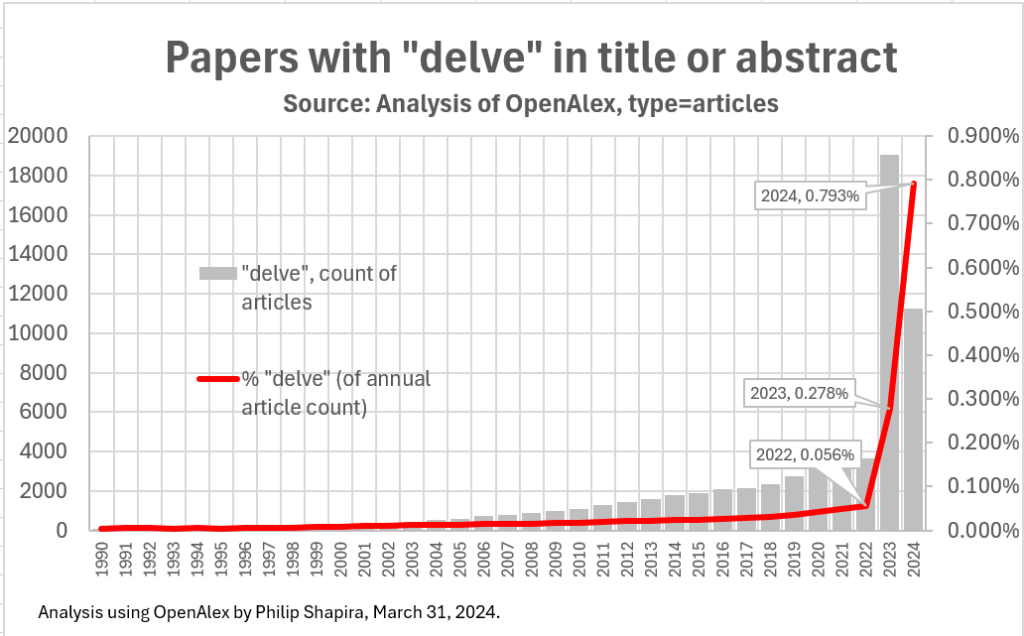
Delving into “delve”
If scientific authors use ChatGPT in writing their papers, it is likely that common ChatGPT words will appear.

https://pshapira.net/2024/03/31/delving-into-delve/
explore captivate tapestry leverage embrace resonate dynamic testament delve elevate
The 10 Most Common ChatGPT Words - AI Phrase Finder
What words are overused by ChatGPT? We studied a huge dataset of ChatGPT responses and can tell you the 10 most common words

https://aiphrasefinder.com/common-chatgpt-words/

Four Singularities for Research
The rise of AI is creating both crisis and opportunity

https://www.oneusefulthing.org/p/four-singularities-for-research