

 Seonglae Cho
Amygdala
When a near-death experience or an extremely strong fear signal occurs, overlearning happens not only in the hippocampus but also in the amygdala, which is attached to the end of the hippocampus. This can become a persistent framework for interpreting the world based on that memory, so it does not fade even if it is not actively used—resulting in an inefficient (maladaptive) interpretation. (PTSD) Bringing that memory up and “overwriting” it so that it can be recalled without re-experiencing the pain is key to addressing this problem.
The larger the amygdala—which governs emotional responses such as anxiety and fear (the desire to avoid)—the stronger libido tends to be. This can be interpreted as a tendency to want “forbidden love.”
There are even Marvel characters: villains without an amygdala.
If the temporal lobe is removed, it can lead to psychic blindness.
e.g., the Robogator Experiment
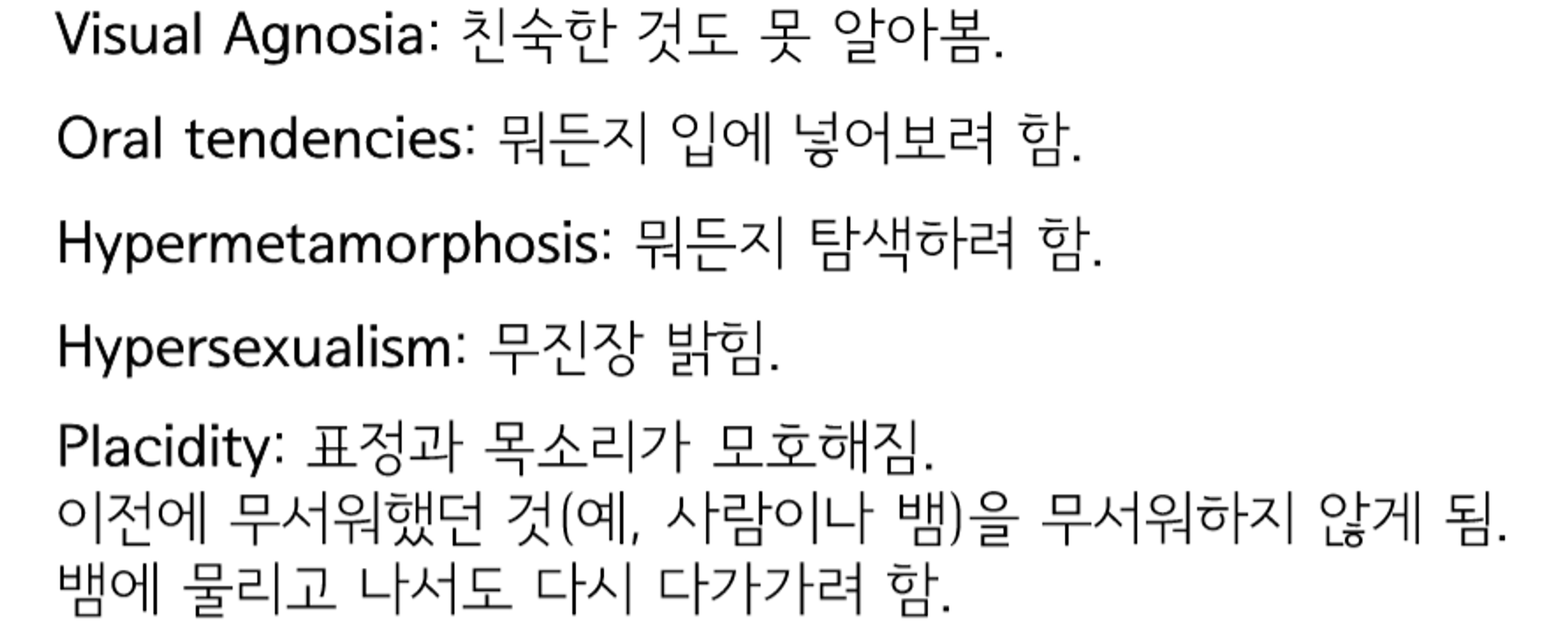
Functions of the amygdala
1. Fear detection
Two pathways
- high road — slow and analytic: crude signals prime the system → evaluation (fear can occur before the evaluation)
- low road — quick and dirty: related to spatial frequency; there is a shortcut from the thalamus to the amygdala. This shortcut exists not only for vision but across sensory modalities (even when stimuli are shown with split-brain presentation).
Fear priming — the amygdala maintains a vigilant state toward the environment and detects fear cues via rapid, unconscious fear detection.
Sclera (the whites of the eyes) — having a lot of visible sclera is a signal of fear and is prominent in the eyes.
→ Patients with amygdala damage do not look at the eyes (they can detect other facial expressions well, but miss expressions where the eyes are the critical cue).
Conclusion: fear belongs to the unconscious domain. The amygdala detects fear cues and alerts other brain regions, redirecting attention.
Masking paradigm — masking: sensory processing of a briefly presented weak stimulus is disrupted by a stimulus presented immediately afterward (useful for consciousness research).
2. Fear learning
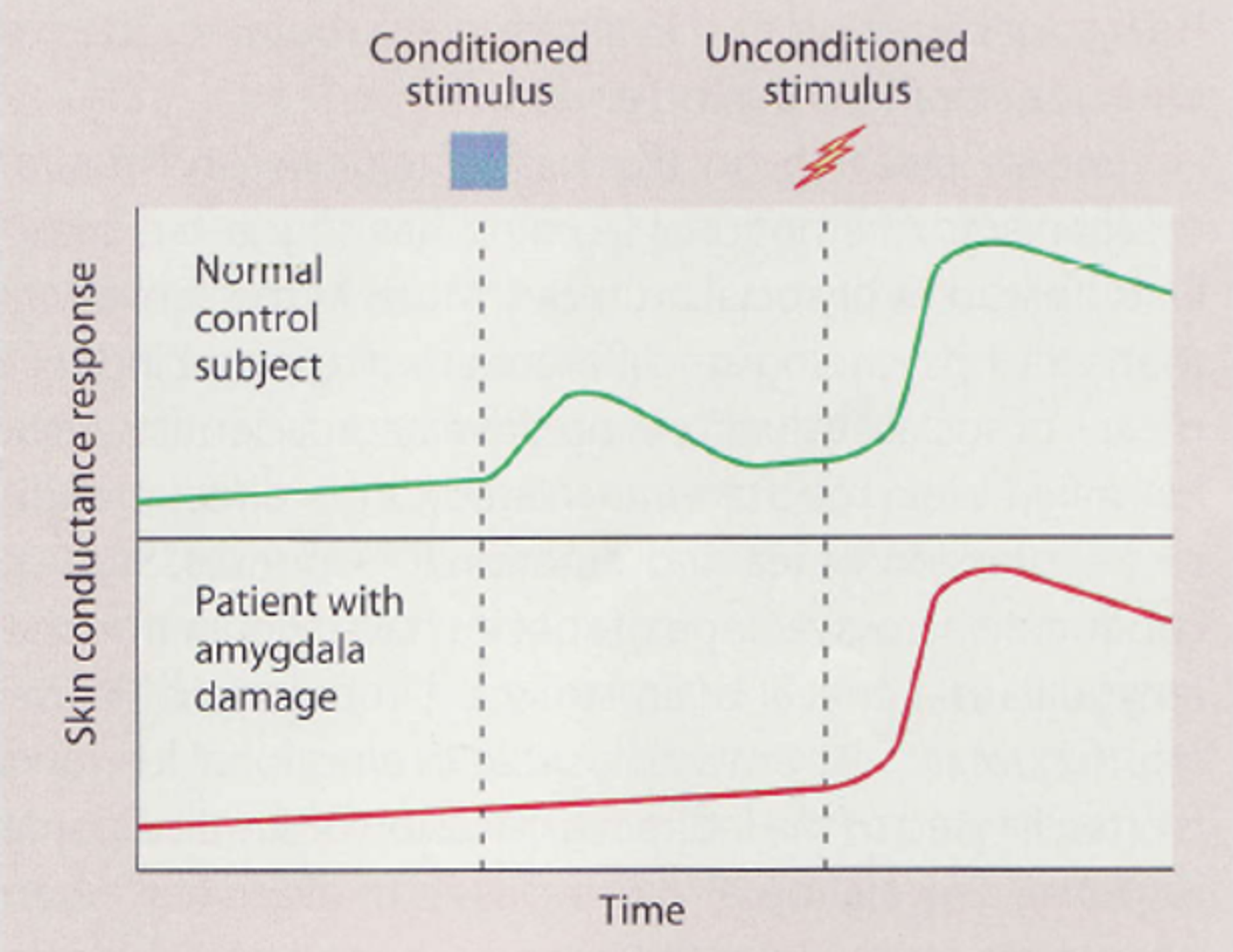
Fear conditioning does not occur when the amygdala is damaged.
Amygdala damage: no preparatory response to the CS (no fear), but the person knows what the cue is.
Hippocampal damage: a preparatory response to the CS occurs, but the person does not know what the cue is.
Skin conductance response — similar to freezing behavior. When shocked, a fear response occurs: Skin Conductance Response (SCR) = Galvanic Skin Response (GSR), the principle behind lie detectors.
Social learning of fear — seeing another person fear something can make you fear it too.
Vicarious learning — observational conditioning — is also handled by the amygdala.
The amygdala and sociopathy
Psychopath < sociopath: “sociopath” is a more appropriate psychological term (fewer cases, less information; they can hide it well).
Causing socially negative events.
Typically, a smaller and less active amygdala → antisocial tendencies.
This shows that fear plays an important role in social functioning as well — fear-learning-based empathy.