

 Seonglae Cho
A brain map that comprehensively represents the connections between neurons in the brain, essentially a brain circuit diagram.
Published in the Open Connectome Project
A unique personal property that differs even between twins
Connectome Notion
FlyWire
FlyWire
Since 2019, scientists and experienced proofreaders have utilized FlyWire to proofread AI segmentation of a
full fly brain (Dorkenwald et al., Zheng et al.). As of October 2024, the flagship FlyWire paper, Neuronal wiring diagram of
an adult brain, has been published in Nature, which includes 139,255 proofread neurons
(Dorkenwald et al.).
The companion papers include hierarchical annotation of all proofread neurons
(Schlegel et al.)
and a comprehensive cell type catalog of the visual system
(Matsliah, Yu et al.).
https://flywire.ai/
FlyWire

https://ngl.flywire.ai/
Virtual Fly Brain
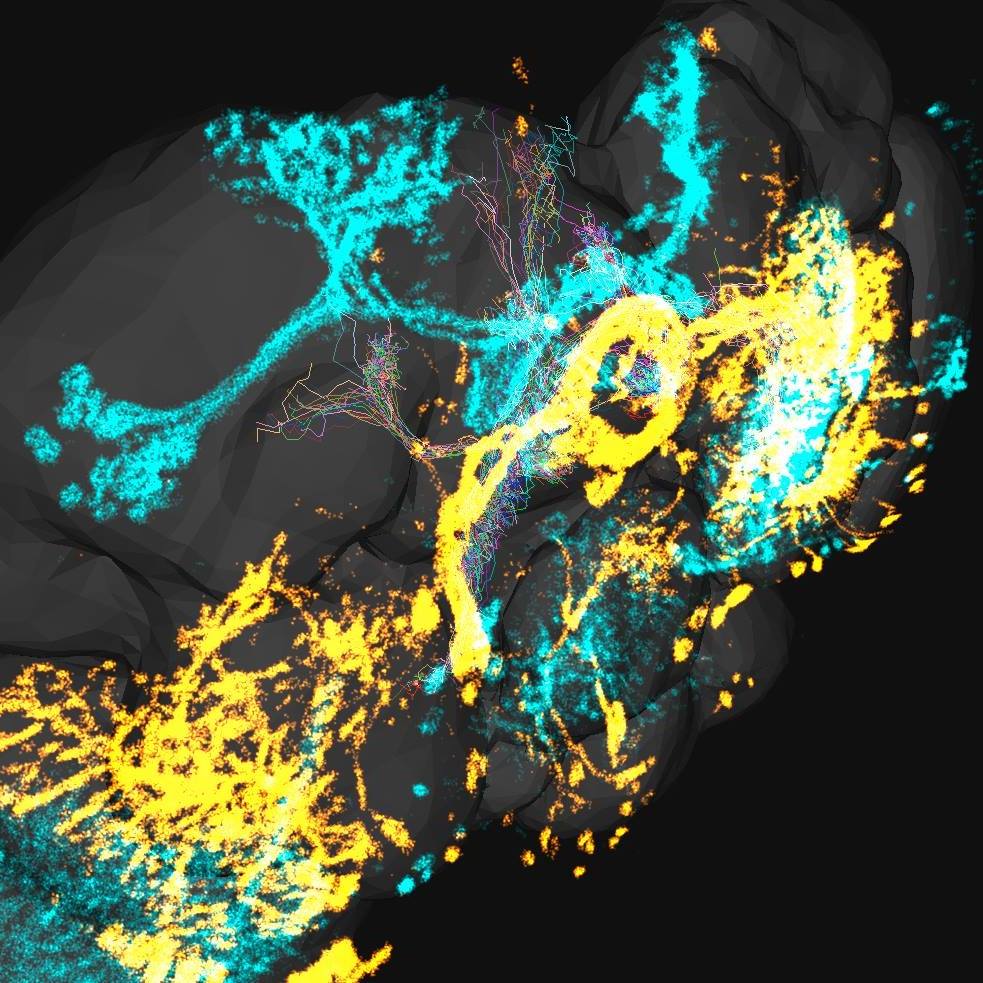
Welcome to Virtual Fly Brain (VFB) - an interactive tool for neurobiologists to explore the detailed neuroanatomy, neuron connectivity and gene expression of Drosophila melanogaster. Our goal is to make it easier for researchers to find relevant anatomical information and reagents. We integrate the neuroanatomical and expression data from the published literature, as well as image datasets onto the same brain template, making it possible to run cross searches, find similar neurons and compare image data on our 3D Viewer.
https://www.virtualflybrain.org/
Open Connectome
Open Connectome
J. T. Vogelstein, E. Perlman, B. Falk, A. Baden, W. Gray Roncal, V. Chandrashekhar, F. Collman, S. Seshamani, J. L. Patsolic, K. Lillaney, M. Kazhdan, R. Hider, D. Pryor, J. Matelsky, T. Gion, P. Manavalan, B. Wester, M. Chevillet, E. T. Trautman, K. Khairy, E. Bridgeford, D. M. Kleissas, D.

https://neurodata.io/project/ocp/