 Seonglae Cho
Parameter Interpretability
Weights are a vector in parameter space. Attribution is an effect of weight and feature is an effect of representation. The motivation for the weight-similarity is to avoid components sharing param.
- SVD cannot treat Superposition Hypothesis
- NMF also limited to Superposition Hypothesis
Weight Interpretability Notion
Weight Interpretability Methods
2017
Nonlinear activation functions inside neural networks create interactions within shared hidden units (common hidden units), and these interaction pathways are encoded in the weight matrix. Based on this idea, the Neural Interaction Detection (NID) framework was developed to detect interactions by directly interpreting the weight matrix. NID approximates the importance of units in the first hidden layer using the weights in higher layers (), and quantifies the interaction strength for a given feature set as follows.
Here, is the weight connecting input feature to hidden unit , and the operation captures a “non-additive effect” in which that hidden unit is simultaneously activated by all elements of the feature set . As a limitation, in densely connected Clique structures among variables, it can be difficult to clearly distinguish a true high-order interaction from multiple lower-order interactions.


Bilinear MLPs
Achille and Soatto (2018) studied the amount of information stored in the weights of deep networks
There is little superposition in parameter space. Linearity in parameter space is a reasonable assumption.
Transformers contain a core subnetwork with very few parameters (≈10 million) that can nearly perfectly perform bigram (previous token only) next-token prediction (achieving r>0.95 bigram reproduction even in models up to 1B parameters). These are essential to model performance (concentrated primarily in the first MLP layer). Ablating them causes performance to collapse dramatically.
The first layer induces a sharp rotation from current token → next token space. The layer simply reorients activations from a 'coordinate system that describes the current token' to a 'coordinate system that describes the next token'. This serves as the minimal starting point for complex circuit analysis (minimal circuit).
Circuit-level reverse engineering
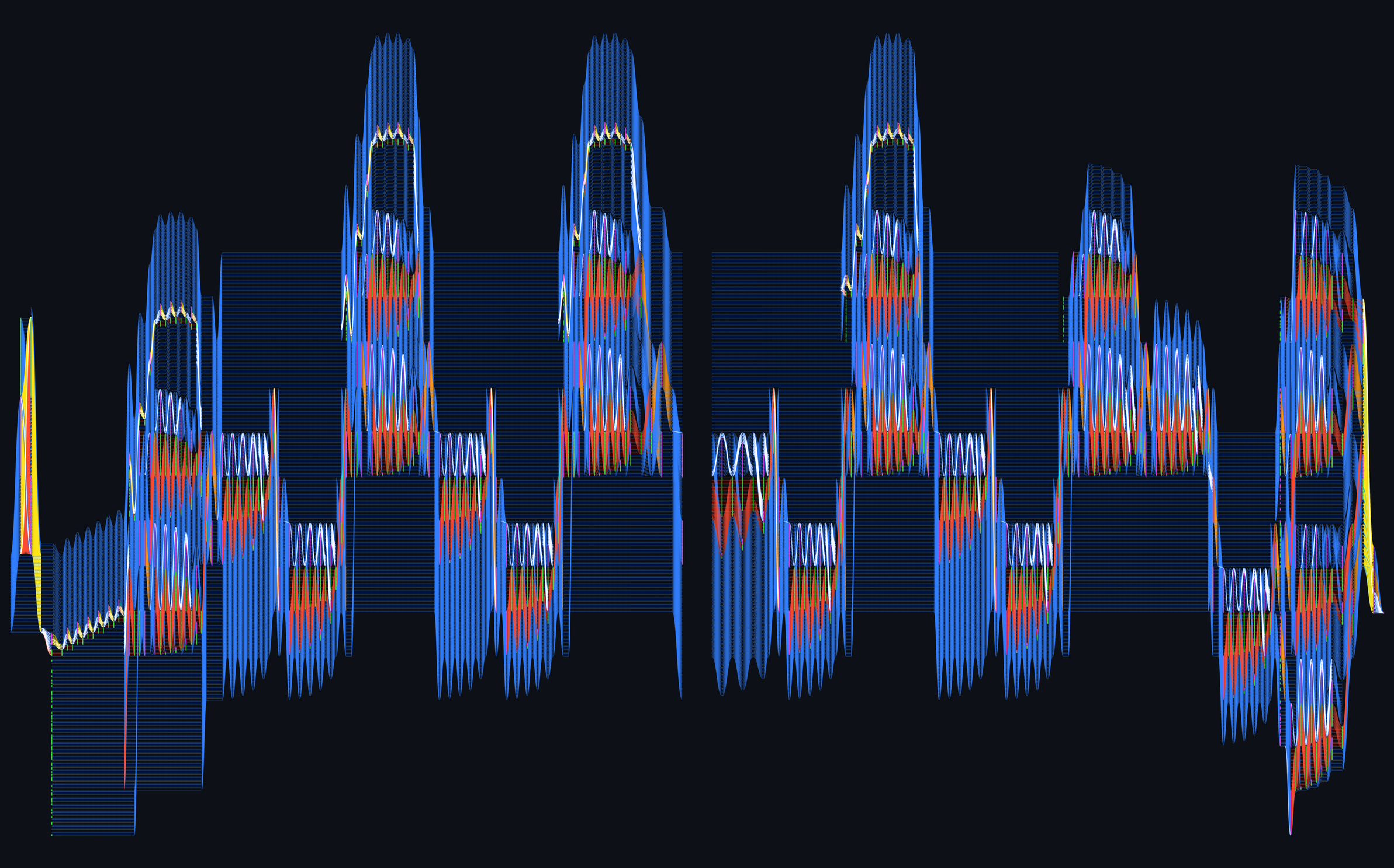
The ML puzzle released by Jane Street was the problem of "interpreting what a neural network with fully disclosed weights actually computes." At first glance, it appeared to be a strange network that almost always outputs 0, but analyzing the final layers revealed that it was internally checking whether the input matches a specific 16-byte value. After extensive analysis, a participant named Alex discovered that the network was actually a hand-implemented complex computation, and the key insight was that it is a circuit-style neural network that computes MD5 hashes. Initial attempts to brute-force it with SAT solvers and linear programs failed due to excessive complexity, but by observing the repeating layer structure and reasoning toward hash functions, Alex ultimately identified it as MD5.
A tip for neural network reverse engineering is to start from the last layer. Look at the layer sizes and repeating structures, and consider what the periodic repetition patterns resemble.