 Seonglae Cho
Pattern analysis, Imagination
Future prediction is integration, and rule decomposition is differentiation. Derivation is the process of obtaining local rules (direction/velocity/slope), while Integral is the process of advancing the state forward according to those rules. In other words, because differentiation is definable, it provides guidance on how to handle each specific data sample or each instance of reality. Inference is integration; it approximates the uncertain future prediction. Therefore, training is differentiation and inference is integration.
When people predict the future, especially futures driven by technology, there are common factors they tend to overlook. First, change occurs continuously. Any change in human society does not happen abruptly; there are countless intermediate stages, and it takes time for changes to spread spatially and temporally. Second, change is not limited to occurring through a few people or actors. People like stories, so they think that everything can be simply explained by a few actors and that all changes are determined by their decisions, but in reality, countless people's decisions are involved in change, making it very conservative and going through various stages. Finally, the speed of change in people's perceptions and behavioral patterns is extremely slow. People fundamentally find change bothersome and dislike it, so technology doesn't determine behavioral patterns—rather, behavioral patterns determine the direction of technological development. In other words, technological development moves greedily in a direction that minimizes short-term changes in habits, so even if there is a long-term vision, the resulting form of technology can be completely different as it adapts over a long period of time.
- The biggest force driving the market is also The Action Principle, and changes occur sequentially according to the principle of efficiency. (Slow take-off).
- Future prediction is physically impossible to measure accurately compared to past prediction due to the Uncertainty principle
Culture is state and technology is action for future state
Industry always follows Scalability rule.
If it occurs beyond prediction, interpretation should be limited to the minimum size area. (Occam's Razor, Hasty generalization)
Future Prediction Notion

We tend to overestimate the change that will occur in the next year and underestimate the change that will occur in the next decade.
Society view


Human view

Dataset & AI
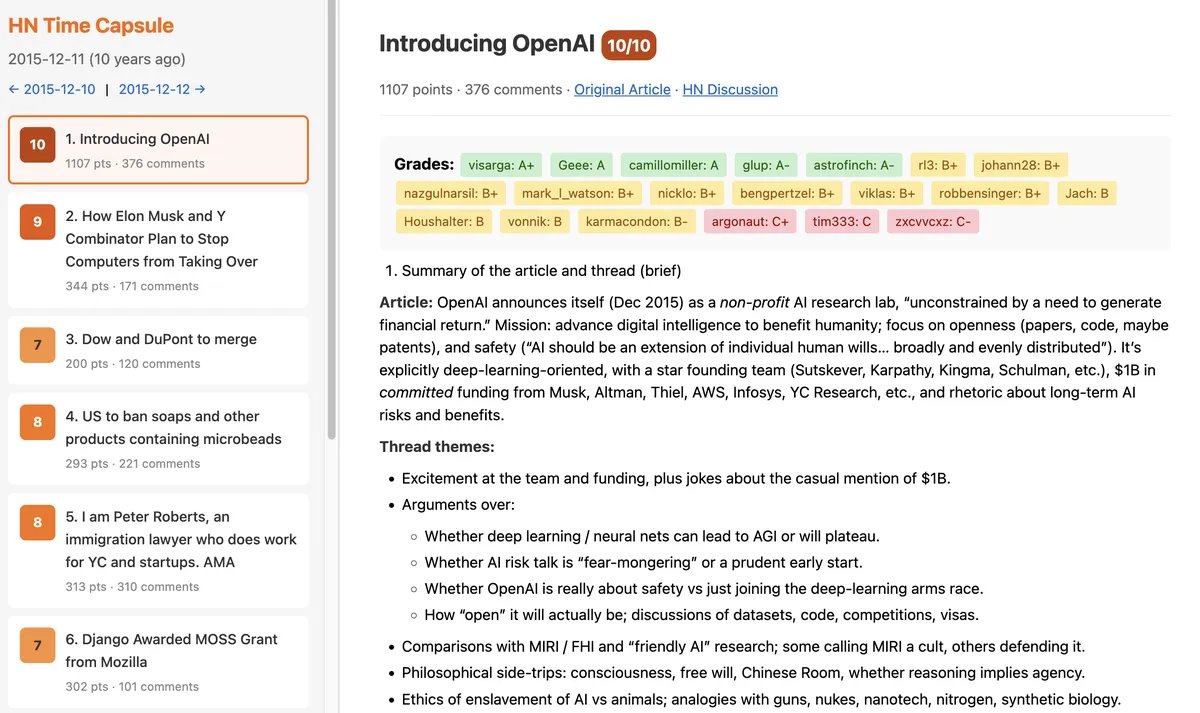
hn-time-capsule
karpathy • Updated 2026 Sep 2 3:49